
Although Urladam Book Festival 2026 ended a month ago, its profound impact and lasting lessons still linger. And we continue to discuss them today!
The cultural events featured at the manifestation share the fundamental and sublime commitment to exploring ‘The Human Condition’, the overarching main theme of the latest festival. They all give voice to relevant ethical elements, such as HUMAN DIGNITY, RESILIENCE, AND HOPE IN THE FACE OF HARDSHIP. In other terms, the central moral ingredient across these works is the defense of human dignity, the perseverance and the power of hope despite systemic suffering.

For this reason, we have chosen four very particular panels from the captivating bulletin to demonstrate they possess a valuable common background that intersects the moral crossroads of social justice, empathy for the marginalized, and resistance against the eroding forces of material greed and exploitation. Under the proud festival’s title, these cultural moments argue that true human virtue is found in solidarity, preserving our conscience, and defending the vulnerable and human rights.
Moving forward with this piece, we will concentrate our efforts on:
1. HER TEPEDEN BİR GÜN DOĞAR, as an example of a staged reading
2. MERHABA YAŞAR KEMAL!, as an example of a talk, reading, and musical performance (söyleşi, okuma, dinleti)
3. SİRKTE NELER OLUYOR as an example of children’s literature.
4. ZAMANSIZ’DAN PARA GÜRÜLTÜSÜ’NE LATİFE TEKİN’LE SÖYLEŞİ, as an example of conversation about literature
Just to summarize:
● the first one honors the mythic resilience of seasonal workers and poor Anatolian villagers (Meryemce and her companions) who embark on a dramatic and fatal journey to survive. The moral teaching lies in their unbreakable endurance and the absolute belief that ‘every sunset brings a new dawn’
● the second one echoes these identical moral virtues by exalting Kemal’s literary legacy, which always supported the marginalized, the oppressed, and the moral conscience of the common man
● the third and the last are focused on Anti-Materialism, Critique of Systemic Injustice and Ethical crisis of modern civilization. For instance, ‘Para Gürültüsü’ directly underscores how a hyper-financialized digital era acts as an oppressive regime that erases any human empathy due to the alienation of the human soul under the noise of money. Finally, ‘Sirkte Neler Oluyor’ dissects modern labor relations, social inequalities, and class struggle. Obviously, it advocates for justice and solidarity against a chaotic, theatrical socio-political machine.
Well, let’s examine the four panels!
🔴 HER TEPEDEN BİR GÜN DOĞAR WITH NAZAN KESAL AND TAYFUN ERARSLAN 🔴
Yaşar Kemal featured prominently at the Third Urladam Book Festival through two distinct artistic presentations: ‘Her Tepeden Bir Gün Doğar’ (A Day Rises From Every Hill) and ‘Merhaba Yaşar Kemal’ (Hello Yasar Kemal!).
The first one was a dedicated stage reading adaptation of his ‘Ortadirek’, performed on June 18 by Nazan Kesal and Tayfun Erarslan, with the precious text arrangement by Şenay Tanrıvermiş, direction by Berfin Zenderlioğlu, and musical layers by Zülfü Livaneli.
The second one consisted of a very special multidisciplinary panel with Kenan Mortan, Figen Gürsoy, and Güvenç Dağüstün, held on June 20. This eclectic show made use of the cultural backdrop of ‘Orta Direk’ and the broader ‘Wind from the Plain’ trilogy to analyze Yaşar Kemal’s specific portrayal of the human condition, migration, and all the social injustices and struggles of Anatolian seasonal cotton workers.


This dramatic reading really offered art lovers a mesmerizing and remarkable evening that combined literature and theater in a charismatic mix. In brief, a novel did take the stage and became real through the readings of moving passages from master Kemal’s unforgettable work ‘Ortadirek’. Blending the sublime storytelling of literature with the compelling interpretation of theater, this poignant tribute took the audience on an extraordinary journey through Çukurova, Kemal’s homeland. The stars of the event were the esteemed actors Nazan Kesal and Tayfun Erarslan, even though the main protagonists were the novel’s characters and the hardships of village life, that really came to life once again on stage. Thus, we must confess that this particular show was a concrete and outstanding meeting point for Art and Literature, as it went beyond being a mere adaptation of a literary work. Actually, it presented a powerful narrative that managed to merge stories of HOPE, RESISTANCE AND HUMANITY onto the stage. As a result, the audience were definitely touched and deeply affected, and gave a deserved and prolonged standing ovation in appreciation of both the literary depth and the stage performances.


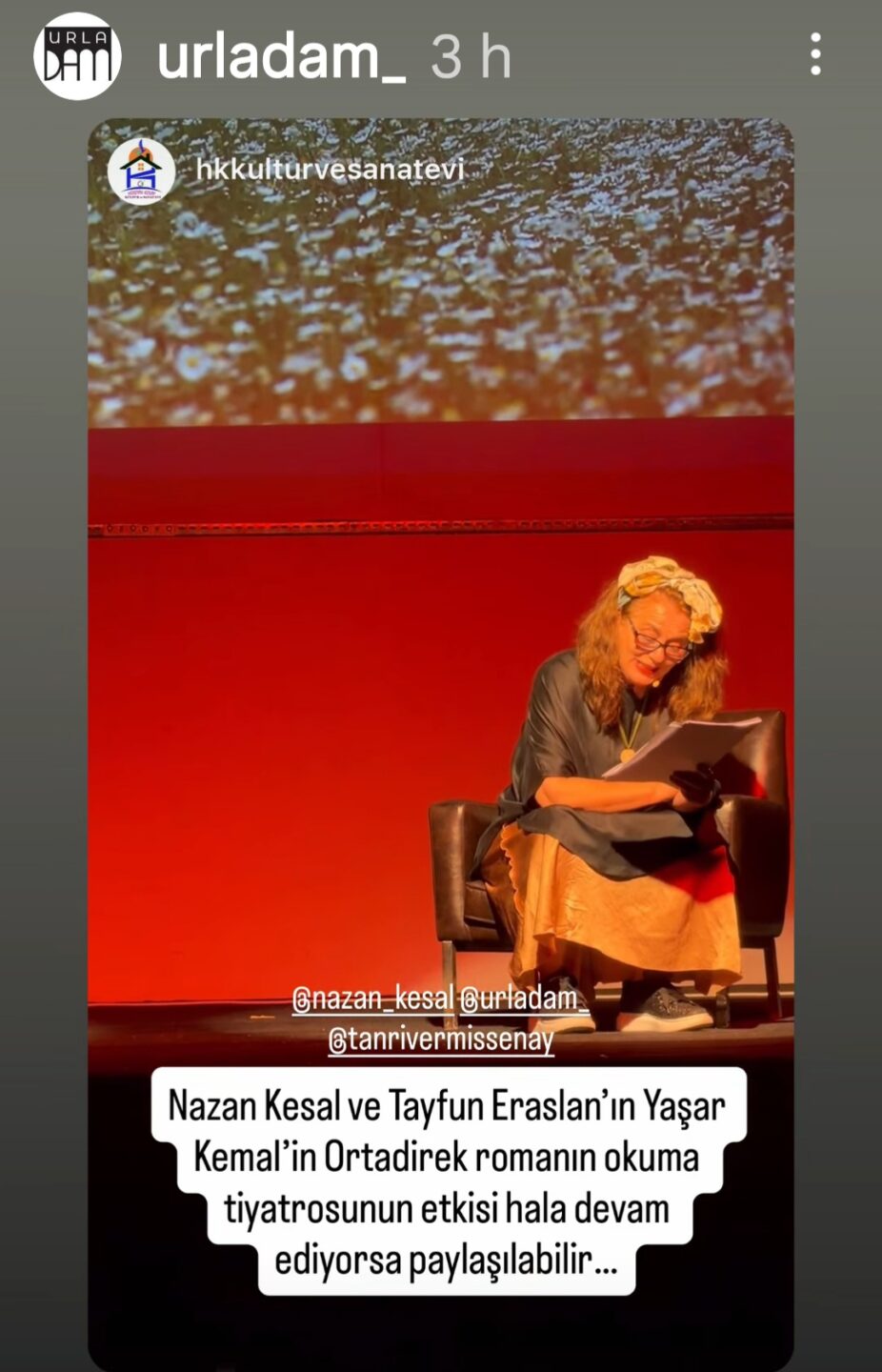
As noted earlier, this prestigious staged reading production
adapted from the monumental novel ‘Ortadirek’ and the poem ‘Kapı’ (The Door), was created in collaboration with the Yaşar Kemal Foundation and mixes theater, live music, and documentary cinematography. So let’s take a look at the stellar CREATIVE TEAM AND CAST that were able to realize this chef-d’oeuvre:
– Performers: actors Nazan Kesal and
Tayfun Erarslan
– Concept and Direction: Berfin Zenderlioğlu
– Text Adaptation: Şenay Tanrıvermiş
– Documentary Visuals: filmmaker Nebil Özgentürk
– Music: Composed by Zülfü Livaneli.

Talking about the PLOT, the show does capture the epic spirit of Kemal’s Çukurova (Cilician Plain) narratives, focusing heavily on the iconic female character, Meryemce.
Regarding the CORE THEMES, the attention is inevitably centered on:
● the MIGRATION STRUGGLE, as it talks about the grueling story of
seasonal cotton workers descending from the Taurus Mountains to the Çukurova Plains. Therefore it concerns their suffering and tragic race against time and poverty to survive
● HUMAN RESILIENCE, because it emphasizes the ancient endurance, labor, and great solidarity of Anatolian peasants
● last but not least, the UNIVERSAL HOPE: no matter how deep the darkness or fatal oppression, Hope and Light will always shine brighter and break through

Yaşar Kemal’s legacy is a so precious cultural treasure reflecting all the elements of the social and artistic life of ANATOLIAN PEOPLE. Surely we can affirm he was someone who carried them to the level of literature, as his works do snapshot the pure and innocent nature of local people, as well as the violent personality stemming from feudalism and custom. Since he was one of the representatives of the social realist novel, his topics are a direct reflection of the social life of every segment of Turkish society.
As affirmed a few lines ago, in his pieces it is possible to see
● the terrible POVERTY that emerged due to the unjust income distribution arising from the feudal structure
● the HELPLESSNESS and despair of the people from Çukurova. Especially, the trilogy ‘The Other Side of the Mountain’ (Ortadirek, Yer Demir Gök Bakır, and Ölmez Grass) analyzes the difficulty of their living conditions and their efforts to cling to life
● the EXPLOITATION ORDER brought by the feudal system, economic injustice, superstition, human-nature relationship, political oppression and social violence

MERYEMCE is one of the most famous and iconic fictional characters in Turkish literature and, first and foremost, the absolute protagonist of the story. She is the resilient ‘lynchpin’ who holds a family and community together through sheer strength and determined willpower. Simply the backbone, the pillar of the family, an indestructible rock.

Meryemce is described as a fiercely stubborn, proud, and resilient 80-year-old matriarch from the impoverished village of Yalak in the Taurus Mountains. She embodies the ultimate symbol of endurance for the rural working class of Turkey.

Yaşar Kemal did not just invent Meryemce. On the contrary, she is profoundly connected to his personal life and childhood. As a point of fact, he was inspired by his Grandmother: the author himself explicitly stated that Meryemce was modeled directly after his own grandmother ‘Hırde Hanım’. And like her, Meryemce wore the finest traditional clothes within the narrative to pay homage to that brave woman.

In conclusion, the character ‘Meryemce’ is the emblem of the unbreakable spirit of humanity against poverty, nature, and systemic oppression.


🔴 THE ECLECTIC SHOW WITH KENAN MORTAN, FİGEN GÜRSOY AND GÜVENÇ DAĞÜSTÜN 🔴

As anticipated, ‘Merhaba Yaşar Kemal!‘ is a multidisciplinary performance merging together a talk show/interview, literary readings, and a musical recital. This unique and glorious presentation functions as a three-part journey into the writer’s literary galaxy:
● firstly, Mr Mortan provides the academic and biographical commentary
● secondly, Dr Figen Gürsoy performs emotional live text readings from the Activist’s novels
● additionally, Mr Dağüstün delivers the live musical moment, featuring custom composition and vocal performance tailored to the text.
In a nutshell, this incredible commemorative event celebrating the life and the awesome moral legacy of the legendary Turkish-Kurdish author, was proudly hosted as a headline attraction at the Book Festival in Urla, and happily brought together three relevant Turkish cultural figures, each one taking a distinct role to explore Kemal’s artistic universe. Let’s delve into the skilled depth of their cultural background:
● KENAN MORTAN: a renowned economist, author, and academic who serves as a Professor of Applied Economics at Mimar Sinan Fine Arts University in İstanbul. Born in the enchanting İzmir in 1951, he is highly appreciated for his praiseworthy work in regional planning, political economy, and commercial history. As we said in the previous lines, Dr Mortan guided the main biographical talk and discussion regarding Yaşar Kemal’s impact on world literature
● FİGEN GÜRSOY: an intellectual and presenter who beautifully performed live textual readings, bringing Kemal’s iconic prose and descriptions to life on stage. We wrote a very detailed article on her miniature exhibition last winter at the link: https://downtongazette.altervista.org/human-is-the-world-all-of-yasar-kemals-books-with-miniatures-exhibition-at-urladam-gallery/
● GÜVENÇ DAĞÜSTÜN: a respected opera singer and musician who played some impressive musical compositions tailored to the themes of the author’s work.
Kenan Mortan and Figen Gürsoy collaborate frequently to preserve Yaşar’s legacy across Turkey and abroad. Their work is tied heavily to the very elegant touring exhibition titled ‘İnsan Dünyadır’ (Human is the World), showcasing all 57 of Yaşar Kemal’s books majestically rendered in miniature art forms. They traveled to several locations, including Paris. The international exhibition held its grand opening on October 10, 2025, and just like their events in Turkey, Kenan Mortan accompanied Figen Gürsoy to Paris representing the Yaşar Kemal Foundation (Yaşar Kemal Vakfi). The exhibition opening served as a major cultural gathering for the Turkish diaspora and French literature enthusiasts, attended by officials from the Turkish Embassy in Paris and representatives from the Galatasaray Alumni.

In the ‘Merhaba Yaşar Kemal!’ multidisciplinary tribute, Dr Gürsoy gave voice to the profound words of Kemal from several of his key works, focusing on Anatolian culture and nature. This intense initiative featured poignant passages from ‘Orta Direk’ (The Wind from the Plain), the epic ‘İnce Memed’ (Memed, My Hawk), the mythological ‘Binboğalar Efsanesi’ (The Legend of the Thousand Bulls), and wise reflections from ‘Binbir Çiçekli Bahçe’ (The Garden of a Thousand and One Flowers).
🔴 ERCAN KESAL IN CONVERSATION WITH UMUR TALU 🔴

Mr Umur Talu is a prominent veteran journalist, columnist, and editor. Esteemed for his decades-long career in Turkish media and his advocacy for press freedom and media ethics, Mr Talu is definitely one of the most compelling writers of his generation. His name is inevitably associated with the strong power of his pen, his cultural depth, his elegant ability to enrich the language with great agility with the touch of wise irony in his writing, and finally his neverending knowledge and interest in historical and social matters. The ‘Umur Talu’ X-factor is immediately evident in his written words about current events as it elevate his pieces to the realm of enduring value.

Besides, this very talented star is widely recognized as a MEDIA PIONEER, because he totally re-engineered the ethical and institutional framework of Turkish journalism. At its core, his status as a media pioneer is defined by three major structural and ethical breakthroughs:
-PIONEER OF THE OMBUDSMAN: before Mr Talu, Turkish mainstream media had virtually no systematic, internal self-criticism mechanisms. That’s why he established the very first Ombudsman (Reader’s Representative) institution in the history of the country, creating a formal role within the newspaper dedicated exclusively to evaluating reader complaints, correcting mistakes, and so on…
-ARCHITECT OF THE DECLARATION OF RIGHTS AND RESPONSIBILITIES. As you know, he did not just practice journalism; he codified its ethics in order to protect the public from media manipulation. Therefore, in 1998, Mr Talu was the primary author of the Declaration of Rights and Responsibilities of Turkish Journalists
-INDEPENDENCE: during the late 1980s and 1990s, when Turkish media underwent massive privatization, turning newspapers into corporate monopolies heavily tied to state contracts, the author famously lamented that journalists were being stripped of their social duties, transforming from ‘watchdogs of society’ into ‘lap dogs and sleuth hounds of power’. Thus, he pioneered an operational philosophy that resisted this corporate capture.


If we set aside ‘Social Democracy’ (to which the author contributed a single chapter), just thirty years have passed between his first book and the last one.
In ‘Uçuran Bey Postanesi’, the journalist wrote about a political circus in the style of a fairy tale, while ‘What’s Happening in the Circus’ tells the story of the politics of a circus as a fable. So according to the author himself, over these thirty years a great deal has happened, and a great deal hasn’t: good things, bad things, and truly terrible things. Those three decades encompassed thousands of newspaper columns and millions of wise and meaningful words. However, many years lie ahead, Mr Talu truly desires they will pass with new additions to those thousands of columns and new titles join his books: in essence, he firmly wishes that this ‘age of sheer evil and decay’ will be swept away by the people’s resistance. That is the most relevant ingredient in our daily recipe for a better future and a kinder and more honest world to live.
Before diving into Mr Talu’s latest work, let’s take a step back in time to his very first masterpiece, ‘Uçuran Bey Postanesi’, just to deepen his figure.

As you can see, the full subtitle mentions three particular subjects.
Indeed, here the author used these three figures as satirical archetypes to analyze the political persona of Tansu Çiller, Turkey’s first female Prime Minister, who dominated the country’s politics in the mid-1990s. Among these individuals, the reader can find Pinocchio, as a metaphor for political dishonesty, broken promises, and the fabrication of truths. Also, Joan of Arc, as the symbol of a brave, messianic female savior leading the nation, contrasted against the harsh realities of political failures of her period. Lastly, Charlie Chaplin, useful for investigating the tragicomic and absurd nature of the political scandals and governance style.

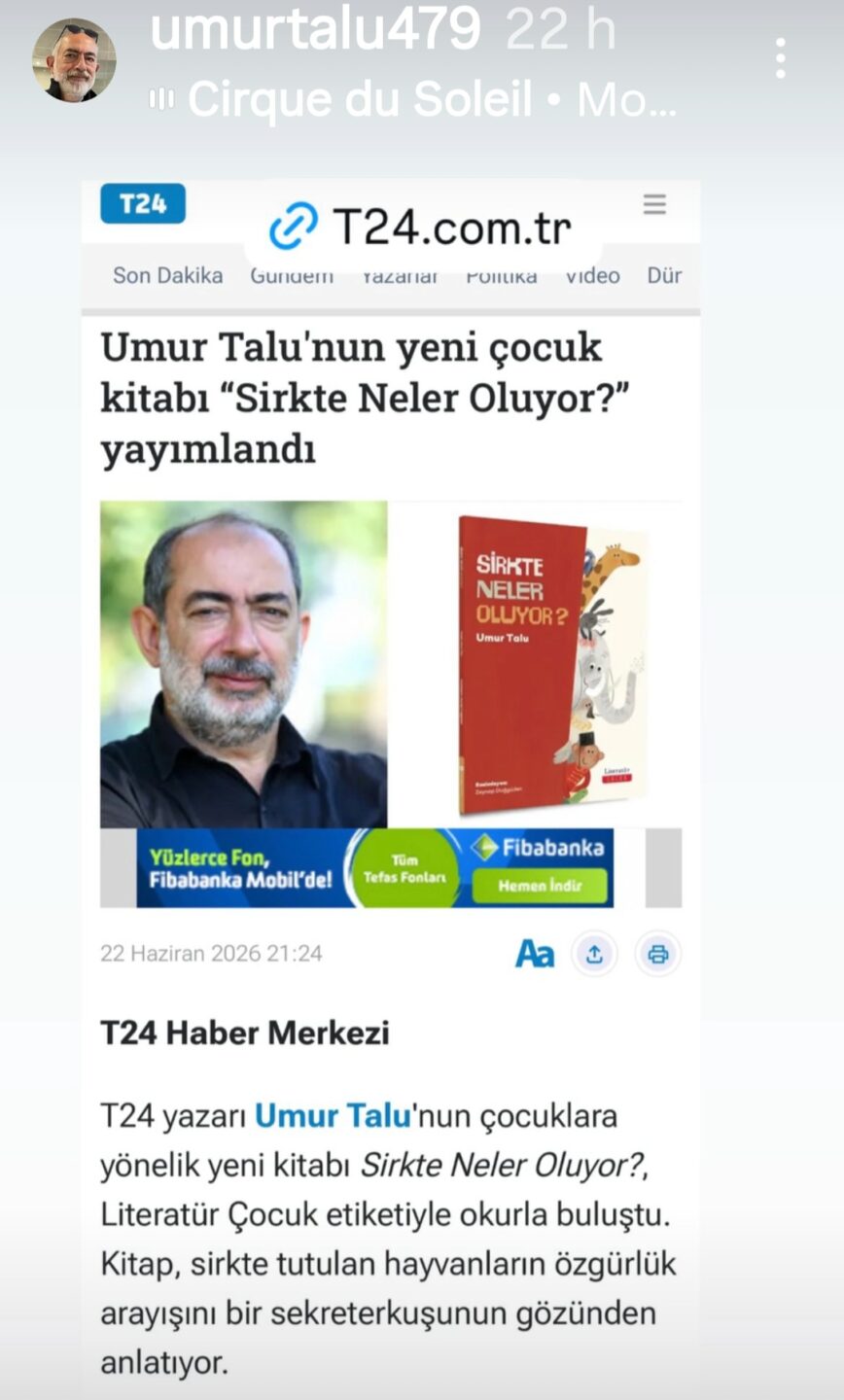
Coming back to Umur Talu’s latest masterwork, I mean the object of his energetic panel at the Third Urladam Book Festival this year, this 32-page book contains a colorful fable format just to deliver an awesome message about freedom, solidarity, and social justice to children aged 6 and above.
As stated earlier, the story follows a Secretarybird who travels across
continents to track down its African animal friends. Unfortunately they are confined inside massive, distant entertainment tents, the circuses. It eavesdrops on a secret meeting held by the captive animals, setting up an extremely suspenseful narrative centered on whether they will successfully break free and regain their autonomy and independence.
As you can imagine, although written for a young audience, this chef-d’oeuvre does heavily mirror Mr Talu’s lifetime of political journalism and social commentary.
No doubt, as the writer himself posted on Instagram, while his previous book treated politics like a fictional circus, on the contrary this one treats circus politics as a modern fairy tale. In other words, the ‘circus’ acts as a metaphor for exploitation and artificial captivity, in a sort of ALLEGORY OF CONTROL. Moreover, to underline the theme of the QUEST OF FREEDOM, the narrative centers on breaking away from forced brutal entertainment and systemic constraints. Furthermore, in homage to the journalist’s regular focuses on labor movements and community organization, the poor animals look for a COLLECTIVE RESILIENCE and savior. In fact, they hold a secret democratic meeting to arrange and plan their own liberation.
In conclusion, all the themes discussed in his latest writing, indirectly recall Umur Talu’s moral values and way of thinking: as a matter of fact, it’s not difficult to understand that anti-fascism, social justice, and the neverending defense of civil liberties are the central pillars of his entire career as a leftist political journalist and author. In his opinion, anti-fascism is not just a political stance, but a fundamental humanitarian necessity for achieving justice, equality, and collective freedom. For this reason, throughout his powerful pieces posted on platforms like Habertürk, Gazete Duvar, and T24, Mr Talu has consistently fought against
authoritarianism in all its forms, by leading a daily critique of Global and Local Fascism in European countries, and also by advocating for an international language of good people to combat the Everyday Fascism that unfortunately marks the normalized social habits of hate speech, racism, xenophobia. Additionally, he still keeps a ‘literary resistance’ up thanks to his recent work ‘Dünyanın Tozunu Atalım!'(Let’s Dust Off the World!), focusing on working-class solidarity and resistance movements against the rising wave of global neo-fascism. Even his children’s book ‘Sirkte Neler Oluyor?’, as we claimed before, proudly serves as a basic fable teaching young readers to reject forced confinement and systemic
control.
Here are a video and some pictures from the book [Instagram]:


🔴 YENAL BİLGİCİ IN CONVERSATION WITH LATİFE TEKİN 🔴


Latife Tekin’s latest masterpiece ‘Para Gürültüsü’ (The Noise of Money) is a contemporary novel that marks a stylistic departure from her traditional magical realism, diving straight into the anxieties of the modern digital age. In effect, as you can read, the protagonist is the young Kikobaki, a financial content creator and YouTuber, able to track digital charts, analyze gold trends, and produce market commentary videos meant for low-income, small-time investors desperately trying to survive economically. On the contrary, his mother Beyzana, a YouTuber too, is interested in spiritual readings. So the boy’s world is full of chaotic and sometimes aggressive user comments underneath his channel and he consequently slips into a deep existential crisis, trying to find a genuine human voice among the sad and bitter noise of capital.
Anyway, the moral pillars of this acclaimed work, point out ‘money’ as a system of OPPRESSION, a sort of an all-encompassing acoustic regime and psychological cage. According to the author, money dictates human behavior, distorts time, and provides the constant anxiety of the working class.
Besides, through the contrast of the guy’s market graphs and his mother’s tarot cards, Mrs Tekin highlights how modern society relies on mere prophecies to cope with the deep uncertainty and helplessness of poverty.
In addition, ‘Para Gürültüsü’ warns against the ALIENATION OF THE DIGITAL LANDSCAPE, characterized by the profound isolation of youth, and the loss of human empathy.
Also, Latife Tekin proposes ‘language’ as the ultimate tool for SURVIVAL AND RESISTANCE. Thus, the inner lyrical voice of Kikobaki serves as proof that the human spirit cannot be entirely erased by artificial intelligence or economic metrics.

The core theme remains the same as that of Tekin’s entire body of work: poverty, social injustice, and the toll they take on us. Kikobaki conveys his message using a more lyrical language. In fact, the scripts of his videos, which make up a significant portion of the book, alongside the comments posted on them are deeply poetic and emotional.
Through the lens of Kikobaki’s story, the particular narrative truly clarifies how our fears, anxieties, anger, competitiveness do manifest in our relationship with money and do shape our behavior. And how the clamor of money is able to distort our daily lives, while humanity is becoming steeped in that unknown substance lying between the age of gambling and the age of delirium.


And what about ‘Zamansız’, the previous work by Mrs Tekin?

Well, Latife Tekin’s narrative ‘Zamansız’ (Timeless) emerged unexpectedly and abruptly during the Covid-19 pandemic, in a new way of thinking. Numerous elements, for instance the fact that the stories are intertwined, pieces of poetry are interspersed, and some sections have an unspecified speaker, clearly indicate that Mrs Tekin embarked on a new writing experiment, as an example of the experimental novel genre. This leads to Latife Tekin’s following expressions regarding her work:
‘I can say this much: just as we thought during the quarantine days how everything changed, how the sky fell on our heads, and that nothing would be the same as before, we must have also thought that it could no longer be written as before, right? I am sure people trying to exist by writing in the world thought about this with a shudder. I grabbed the pen first and foremost to stay alive, not to open a new door to the novel form. Since I deeply felt that I could stand against death only by writing like this, I can say this without hesitation. We can also say that the courage of Zamansız comes from the magnitude of fear‘
The work in question draws attention through the human-nature relationship, the destruction of nature, metafiction, magical realism, metamorphosis, and its poetic narrative aspect. Highly fluid and pastoral, it seems to rely on nature, water, and transformation. The text famously follows the metaphorical and metamorphic journey of characters, who are heavily abstract, spiritual, and fluid entities that shift between human form, flora, and fauna to depict the pulse of a heartbeat and passion. Everything looks placeless and timeless.
☀️ HER PHILOSOPHY OF WRITING: LITERATURE AS A WEAPON OF INNER RESISTANCE
Latife Tekin stately affirms that
literature is a strong weapon of inner resistance, a tool for emotional healing, and a radical language for the dispossessed. Emerging as a prominent literary voice in the post-1980 cultural era of Turkey, the author redefined how social injustice, poverty, and marginalization are portrayed and she operates through the following notable pillars:
● Writing as an ACT OF PURE SURVIVAL AND SALVATION AGAINST VIOLENCE, due to the fact she lived through the traumatic socio-political clampdown of the military coup on September 12, 1980 and she began writing out of sheer desperation. Consequently, she was persuased that, to avoid being completely
shattered by the systemic violence of that period, she had to match
that force with an equally powerful and extremely explosive creative act. From her point of view, literature is a way to reclaim personal and collective autonomy
● A NATIVE MAGICAL REALISM, where she treats the supernatural as a legitimate, everyday survival strategy used by displaced communities to
cope with severe trauma and urban exile
● THE LANGUAGE OF THE POOR
All the writers before her, used the common dominant approach to poverty in Turkish literature with the typical ‘socialist realism’, often treating poor people as passive, tragic figures or ideological concepts. On the contrary, Mrs Tekin proposes a new vision: having migrated
from a rural village to an Istanbul shantytown herself, she longed to claim poverty as her own and rewrite it from the inside out.
📚📚📚📚📚📚📚📚📚📚📚📚📚📚📚
The Festival was an all-encompassing experience, and its profound lessons still linger today! The manifestation brought together a magnetic combination of voices against the backdrop of moral global challenges. Human Condition, first and foremost.
[Urladam Series: Episode 11]
Sources: www.dr.com.tr,www.urladam.com.tr, www.kitapyurdu.com,www.t24.com.trwww.instagram.com,www.akakce.com,www.literarur.com.tr,www.eylulgormus.com,www.idildergisi.com,www.iskultur.com.tr,www.gunaydınankara.com,www.dergipark.org.tr,www.sanatykykultur.com.tr
written by Downton Gazette cultural website and Fontana Shelter Art
downtongazette@gmail.com
Instagram downtongazett, Facebook Downton Gazette

